Decline Without Collapse: Why Sick Systems Persist and What Finally Kills Them
The most important variable in predicting societal collapse isn't how sick the system is. It's whether anything is ready to replace it.
1. The Puzzle
Detroit has lost nearly two-thirds of its population since its peak. Its public schools, pension funds, and infrastructure collapsed so completely that in 2013 it filed the largest municipal bankruptcy in American history. By any reasonable measure, the system failed decades ago. Yet Detroit still exists. People still live there, pay taxes, call the police, and send their children to school. The city functions, in a state of prolonged, visible, stable ruin.
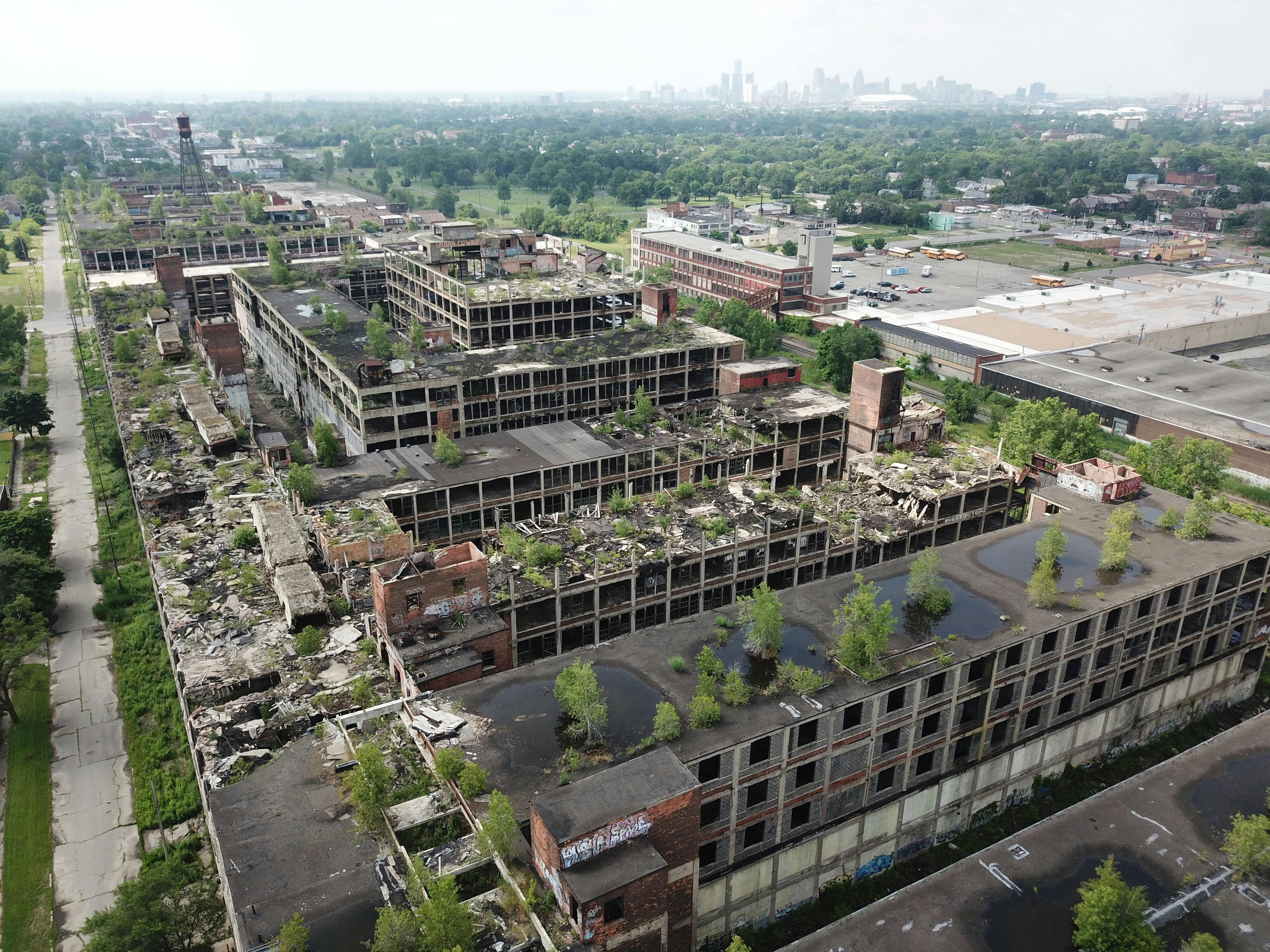
Detroit abandoned industrial buildings
Iran's Islamic Republic has presided over currency collapse, mass brain drain, high youth unemployment (greater than 20%), and three significant popular uprisings (in 2009, 2019, and 2022), each of which was suppressed but none of which made the underlying problems go away. International sanctions have compounded domestic mismanagement. The average Iranian is dramatically poorer in real terms than a generation ago. The regime is broadly despised, particularly by the young. And yet it governs, and seemingly will continue to govern for the foreseeable future.
Sears was arguably dying from the late 1980s onward, losing its identity, hemorrhaging market share, failing to adapt to the retail revolution that was visibly transforming its industry. It declared bankruptcy in 2018, roughly thirty years after its decline started.
The Soviet Union showed clear structural symptoms of terminal decline from at least the 1960s, but did not collapse until 1991.
There is a pattern here that is not predicted by current models and ways of thinking. We expect sick things to die. We are given narratives of broken societies that fail suddenly and violently as if that is the standard trajectory of all societies. What we observe instead, in system after system, is something stranger: a prolonged, visible, measurable deterioration that goes on for years and decades without reaching any resolution. The patient is ill. The decline is obvious. The collapse keeps not arriving.
Understanding why requires rethinking something fundamental about what collapse actually is.
2. What the Scientists Measure
Researchers who study the collapse of complex systems (ecologists, economists, complexity theorists, historians) have developed tools for detecting when a system is losing resilience. The central concept is called critical slowing down.
In a healthy system, disturbances are absorbed and corrected. A population hit by disease recovers. An economy hit by a recession bounces back. A lake ecosystem polluted by a runoff event gradually returns to equilibrium. The system has resilience, which is a capacity to return to its prior state after being knocked away from it.
As a system approaches a tipping point, the pace of recovery slows down. The system takes longer and longer to return to equilibrium after each disturbance.
This framework has been applied to an impressive range of domains. Ecologists have used it to detect approaching transitions in lake ecosystems and coral reefs. Epidemiologists have used it to anticipate epileptic seizures. Economists have applied it to GDP time series and financial markets, with some success in detecting the precursors to the 1987 stock market crash.
Historian and complexity scientist Peter Turchin has built a composite model of what he calls structural-demographic stress. He tracks real wages of unskilled workers, the income share held by the top one percent, signs of elite overproduction (the number of lawyers, MBAs, and political aspirants competing for a fixed number of elite positions), legislative polarization, and the growth of state debt. These variables, he argues, capture the structural preconditions for instability across civilizations from Rome to Imperial China to the modern United States. By these measures, modern societies are showing clear signs of decline.
In 2010, Turchin's model predicted that structural stress in the US would peak in the 2020s — a forecast he committed to publicly a decade in advance. A 2020 retrospective in PLOS One assessed the prediction and found that measures of socio-political instability increased dramatically in the intervening decade, as forecast. The model, whatever its limitations, was capturing something real.
But there is a gap in all of this work. These tools measure the declining resilience of the incumbent system. They say nothing about what happens next. They can tell you, with some accuracy, that a system is approaching a threshold. They cannot tell you whether crossing that threshold produces collapse, prolonged dysfunction, or managed reform. To understand that, you need to look somewhere the literature mostly does not: at the landscape of alternatives.
3. Decline Is Not Collapse
The first and most important conceptual move is to separate two phenomena that the collapse literature persistently conflates.
Decline is a process; the gradual loss of resilience, legitimacy, economic vitality, institutional function, and public trust. It is measurable, often visible, and can extend over very long periods. Collapse is an event, a discontinuity, an institutional rupture, a moment when one system of governance and organization is replaced by another. The process can go on for a century. The event, when it comes, is rapid.
These are not the same thing, and the belief that systems in obvious decline are on the verge of collapse is often wrong. They often are not. And the reason they are not is generally the same.
Collapse requires a viable alternative.
This condition is obvious once stated. It feels like it should be central to the theory of societal collapse, but it largely is not. The mainstream collapse literature, from Edward Gibbon's account of Rome to Jared Diamond's ecological framework to Joseph Tainter's complexity theory, focuses almost entirely on the characteristics of the failing system. The health of the incumbent. The accumulation of its pathologies. The weight of its contradictions. What it almost never examines with equal rigor is the landscape of alternatives; whether anything exists that could plausibly replace the incumbent system, and if so, how viable and organized that alternative actually is.
The implication is profound. A system can deteriorate almost without limit (losing legitimacy, economic function, military effectiveness, public support) and persist indefinitely as long as no credible replacement system is available. Conversely, a system in moderate decline can collapse rapidly if a coherent, organized, and imaginatively legitimate alternative is ready to step into the vacancy.
4. What Makes an Alternative Viable
Not every opposition movement, rebel faction, or reform coalition constitutes a viable alternative. The bar is higher and more specific than it might appear.
A viable alternative needs, at minimum, four things:
The first is organizational coherence; leadership, internal discipline, a means of making and enforcing collective decisions. This is rarer than it sounds. Most opposition to declining regimes is fragmented, personalistic, and prone to internal conflict precisely because the regime has spent years suppressing the conditions under which coherent organization could develop.
The second is resource independence; the capacity to sustain itself financially and logistically without depending on the incumbent system. An opposition that must operate through state-controlled banks, state-licensed media, and state-monitored communications is not independent in the relevant sense. It is, at most, a tolerated faction within the incumbent's perimeter.
The third is elite defection — the willingness of some significant portion of the incumbent system's own leadership class to transfer allegiance to the alternative. Revolutions are rarely made by the dispossessed alone. They are made when members of the existing elite (such as military officers, technocrats, business figures, regional governors) calculate that their future lies with the challenger rather than the incumbent - e.g., the French aristocracy that funded the philosophes, the Tsarist military officers who defected to the Bolsheviks, the South African business community that ultimately abandoned apartheid. Elite defection is almost invariably part of the mechanism by which alternatives become viable.
The fourth, and most underappreciated, is imaginative legitimacy - i.e., the capacity of ordinary people to actually picture the alternative as a functioning government. This is not merely about popularity or preference. It is about whether people can answer, concretely, the questions that any governing system must address: How will order be maintained? How will the currency be managed? How will disputes be resolved? How will the borders be defended?
Many opposition movements can articulate, with great force and clarity, what they are against, but few can answer convincingly what they would do. This gap, between "remove this" and "replace it with this specific thing", is the imaginative gap and it is the most powerful single tool available to any declining regime. As long as the alternative remains abstract, aspirational, and functionally unspecified, the incumbent survives on the anxiety that regime change might produce something worse.
5. The Suppression Instinct
Once the viable alternative condition is understood, the intense energy that declining regimes invest in suppressing opposition can be understood as a rational and inevitable strategy. The decision to suppress might not be consciously rationalized in this way, but is selected for in an evolutionary-type manner. Regimes that suppress alternatives survive longer than those that do not, even if they drive their societies further into decline in the process.
The suppression has four basic strategies, typically deployed simultaneously and in combination, with their breadth and intensity increasing as the regime's vulnerability grows:
Strategy one is the targeted suppression of specific individuals such as dissidents, journalists, and opposition politicians, through the unequal application of vague laws "everyone breaks" to give the process a veneer of legitimacy. In this way the regime manages "troublemakers".
- China's "rumor mongering", "picking quarrels", "spreading rumors" and other vague sedition, subversion, collusion laws.
- Iran's vague "propaganda against the Islamic Republic", "disturbing public opinion", "acting against national security" laws.
- Russia's "extremism", "foreign agent" and "discrediting the armed forces" laws.
- Turkey's "insulting the president" and "terror propaganda" laws.
- United Kingdom's "Non-Crime Hate Incidents" (NCHI) police intimidation, and overly broad and selectively enforced "hate speech" laws.
- Germany's "general insult law" and "special law for insulting politicians" (up to 3 years in jail for an insult - yes really)
- United States "campaign finance", and "process crimes" (lying to investigators, obstruction), or even "mail fraud" laws used to elevate minor non-crimes (lying on a form) to a serious offense if it touched the mail system at any time. All selectively and unequally enforced.
These kinds of vague "get rid of the troublemaker" laws are everywhere once you start looking. They can be applied to almost anyone if you look hard enough and give an illusion of legitimacy for government to silence those troublesome dissenters.
Knowing they are targets, dissenters often post anonymous and on foreign controlled platforms, thus the current wave of "child safety act" type laws, ostensibly meant to protect children from seeing harmful material, but that have the side-effect of eventually requiring a digital ID system and removing all internet anonymity. It is clear that the side-effect is the real goal. Since people bypass age-checks through VPNs the government now wants to control and ID everyone using those as well. Children cannot sign themselves up for a VPN, as it generally requires a credit card or similar barrier to entry for minors. In fact, credit cards are one of the main ways used to 'verify' oneself as an adult by many age-verification companies. Therefore, this movement has nothing to do with protecting children.
Strategy two is the suppression of organizational capacity itself: banning parties, controlling civil society organizations, and restricting assembly and association. The danger is not that a specific person might rally opposition, but that opposition might cohere into an organized force.
Many democratic western and "free" countries have started down this path:
- Germany's attempts to ban the AfD
- France's banning of "far right" parties
- Brazil's disqualification of Bolsonaro from running
- Turkey's ban of any party deemed pro-Kurdish
- Romania's banning of Calin Georgescu, the presidential front-runner, in the middle of an election.
- Spain's extremely harsh crackdown on Catalan separatists over the prospect of a mere referendum (direct rule, mass arrests, long prison sentences, and the removal of the regional government). Especially ironic given Spain's open support for a free and separate Palestine.
- Canada's use of emergency powers and extrajudicial freezing of bank accounts against peaceful protesters who rejected vaccine mandates. (My body my choice? Apparently not)
The best strategy is to prevent organizations from forming in the first place, but often an organization already exists that could take a leadership role in a crisis — an old religion, an established but opposing ethnicity, or entrenched elites with their businesses, land, and community ties that do not align with the government's agenda. Attacking these directly is often too politically costly (at least initially), so a proven but risky long-term strategy is to build and encourage opposing proxies to do it for them. This can be done through mass immigration, bringing in competing religions, cultures, and philosophies. It can also be done by empowering criminals, the poor, and the disenfranchised — the historical brownshirts being the classic example. The 'brownshirt' strategy is then combined with welfare (their effective pay for membership), selective legal enforcement, two-tier sentencing, and favorable media coverage of rebels fighting "the man" — ironic, given they are in fact working for the man against his most credible competition. This strategy is short-sighted: it causes larger problems down the line, but that is treated as a problem to worry about later.
Strategy three is the suppression of ideas through things like internet filtering, curriculum control, historical revisionism, and language policing. The regime is trying to prevent alternatives from becoming thinkable - not merely from becoming organized.
In terms of historical revisionism, Canada created imaginary "mass graves" and a native holocaust out of thin air. A holiday was created to memorialize the non-existent victims at the peak of the moral panic. Over 100 churches were attacked (graffiti, vandalism, arson) with over 30 of those being arson, all with little to no consequences and little effort into investigation (as this is the sanctioned work of the 'brownshirts'). These attacks were also not framed as a hate crime or mischief as would have been done for any other religious group. All this was done because, while waning in influence, Christians are still a large and independently organized social force — and so must be discredited and dismantled. Other religions are present too, but their smaller numbers and shallow history (in Canada) make them less of a structural threat to the regime's ideological control.
Or in another instance the US democrats created an "insurrection" from unarmed protesters, some of whom did become violent and riot, but were given sentences way beyond their peers in similar situations and with similar crimes e.g. BLM rioters, antifa on a Tuesday, the New York thug committing his 100th crime while out on bail. Non-violent trespassers and people who were not even attending but who had promoted the protest were given extreme sentences as "organizers".
Statues of past leaders and heroes are ripped down and replaced with generic low-quality "everyday 'minority' woman" statues instead. Heroes have ideas and examples that can be referred to and rallied behind and so are 'dangerous'. Same goes with the treatment of historical figures in books who are rewritten as villains.
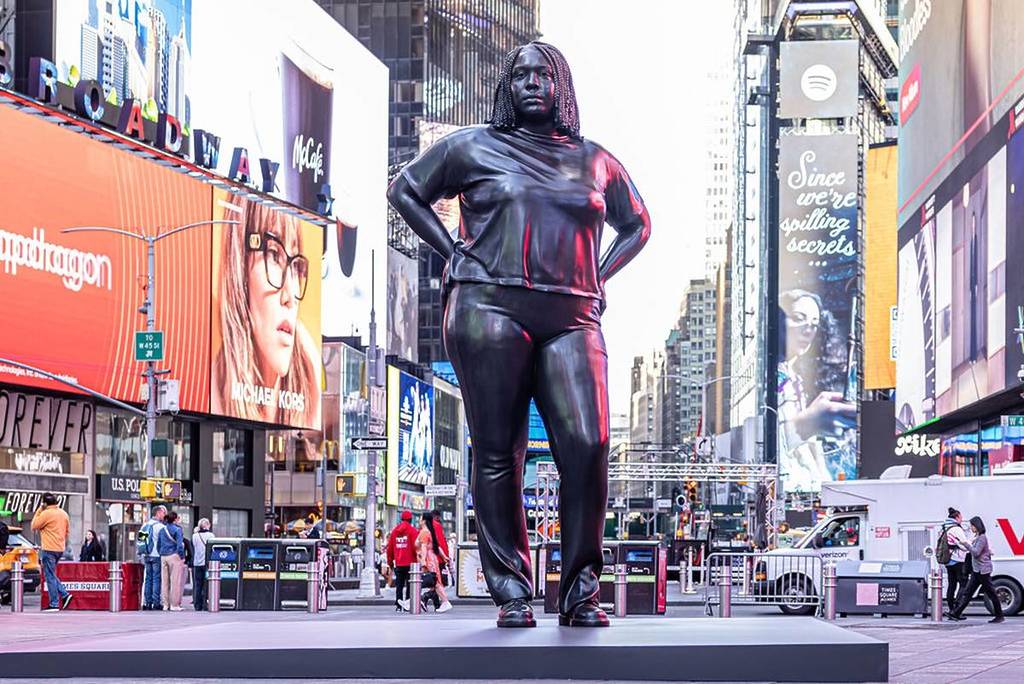
Generic and insulting statue of 'everyday' black woman
Streets, parks, waterways, and buildings are renamed to unpronounceable gibberish. No one can read these new names, not even the natives whose language it is 'supposed' to be from.

Can you take me to .... ah never mind.
Strategy four is the suppression of private thought itself, involving informant networks, family surveillance, and enforced self-censorship. Citizens cannot safely voice dissent even in their own homes. North Korea has maintained this extreme strategy for decades. The Soviet Union approached it at its peak.
All of these strategies are employed simultaneously, with the strength and reach increasing over time.
The force with which a regime implements these strategies reveals its own fragility. A government that needs to control what its citizens say in private conversation is a government that knows it would not survive free expression. The suppression intensity is the regime's own revealed estimate of the gap between its legitimacy and its survival.
Regimes starting down this path are caught in a dilemma. The same suppression that prevents viable alternatives from forming also prevents the internal reform that might arrest the decline. Genuine reform — such as restructuring institutions, redistributing power, and creating new mechanisms of accountability — requires exactly the kind of organizational space, independent resources, and elite defection that the regime is systematically preventing. Gorbachev's glasnost is the defining illustration: he intended a controlled loosening to revitalize the Soviet system and instead created the organizational conditions for viable alternatives to emerge in the Baltic states, in nationalist movements, and in parallel economic structures. The Soviet system collapsed within a few years of his reforms, as opposition became enabled by them. Therefore, the instinct to suppress is correct from the incumbent's narrow perspective. It is also, almost always, the thing that makes genuine recovery impossible.
6. The Structural Enablers of Prolonged Decline
Even setting aside active suppression, several structural features of complex systems extend the sick period far beyond what intuition would suggest. Decline persists not only because regimes prevent alternatives, but because the systems surrounding any large institution have interests of their own in its continued existence.
Institutional inertia is the most basic. Any large system (a city, a corporation, or a government) exists in a web of dependencies. Suppliers, creditors, employees, customers, and regulators all have investments, explicit or implicit, in the system's continued operation. Even a system that is clearly failing continues to receive support from these constituencies because the costs of its immediate failure, for each of them individually, exceed the costs of its continued dysfunction. The result is a kind of collective propping-up — not necessarily an endorsement of the system, but a rational, individually motivated preference for its continuation over the chaos of its immediate end.
Debt is particularly effective at deferring the reckoning. A declining system can borrow against its future to sustain its present — maintaining services, paying salaries, and funding operations — while concealing from even its own managers the degree to which it is consuming rather than generating value. Municipal governments, failing corporations, and declining states all do this and it can work for a surprisingly long time. It works until the borrowing capacity runs out, which can take decades.
The exit of the capable creates a perverse stabilization at a lower equilibrium. As a system deteriorates, those with the most options such as the most educated, the most economically mobile, the most energetic, are the ones who tend to leave. This is rational for each of them individually, but it has collective consequences. The people most likely to organize reform, or to constitute viable alternatives, exit. What remains are those who cannot leave such as the elderly, the poor, and the deeply rooted. This reduces the pressure for reform and simultaneously reduces the energy available for dramatic transformation. The system stabilizes in its degraded state, deprived of the people most capable of either fixing it or replacing it.
Elite management of popular suffering is perhaps the most underappreciated mechanism of all. Turchin's structural-demographic theory makes this point explicitly: the trigger for visible collapse is almost never the suffering of ordinary people reaching some threshold of intolerable misery. It is elite defection. It is the moment when members of the governing class calculate that the alternative is preferable to the incumbent. Popular suffering can be managed, absorbed, or simply ignored for very long periods as long as elites remain unified behind the incumbent. The Roman grain dole, medieval poor relief, and modern welfare states are all, among other things, mechanisms by which elites manage popular suffering to prevent it from reaching the organizational threshold at which it would threaten their position.
For the people actually living inside declining systems (the Detroit resident whose schools have collapsed, the Iranian young person whose economic future has been consumed by sanctions and corruption, the citizen of any failing state watching institutions hollow out around them) collapse is not a future event to be predicted. It has already happened.
7. Historical Collapse, Reread
With this framework in place, the canonical cases of societal collapse look somewhat different.
The fall of the Western Roman Empire (conventionally dated to 476 AD) is typically narrated as the endpoint of a long decline: military overextension, fiscal collapse, political corruption, barbarian pressure. All of that is accurate. But the decline had been obvious for over a century before the traditional collapse date, and what actually changed in the fifth century was not primarily the depth of Roman decay, but the organizational capacity and territorial coherence of the successor Germanic kingdoms. The Visigoths, Vandals, and Ostrogoths were not simply predators exploiting Roman weakness. They were, increasingly, viable alternatives: organized, led, capable of administering territory, and willing to absorb Roman administrative structures into their own. The collapse happened when the alternative became viable, not when Roman dysfunction reached some internal threshold.
The Russian Revolution of 1917 is illuminating in a different way, because Lenin was extraordinarily explicit about the theory. His entire doctrine of the vanguard party, developed in What Is To Be Done? in 1902 — fifteen years before the revolution — was essentially an argument that a viable replacement system does not emerge spontaneously from conditions of decline. It has to be deliberately constructed in advance, with organizational discipline, ideological coherence, and trained cadre, ready to act when the incumbent system reaches crisis. The Bolsheviks spent years building exactly this structure before 1917. When the Tsarist system broke under the pressure of the First World War, they had something ready. Most of the other revolutionary factions did not, which is why the Bolsheviks won and the others did not.
While the Iranian revolution was possible in 1978 against an authoritarian dictator because of the existence of the well organized Shia clerical establishment, it does not seem to be possible today because there is no viable alternative. Only an outside invasion could change that calculus.
The Soviet collapse of 1991 illustrates the same dynamic from the inside. The structural decline had been accumulating for decades: economic stagnation, technological backwardness, demographic stress, and imperial overextension in Afghanistan. What Gorbachev's reforms did, inadvertently, was create the organizational space for viable alternatives to emerge: Baltic independence movements with genuine popular support and institutional capacity, nationalist parties in the constituent republics, parallel economic structures. The reforms relaxed suppression just enough, just long enough, for alternatives to become viable. The collapse followed with startling speed, because the alternatives were ready the moment the suppression lifted.
The Arab Spring of 2010-2011 provides a natural experiment in the viability condition across multiple cases simultaneously. In Tunisia, the uprising succeeded in producing a genuine transition because a loose coalition of opposition parties, labor unions, and civil society organizations provided sufficient organizational coherence, and because the military chose not to fully back the incumbent. In Egypt, the uprising produced a transition — but to the military rather than to the democratic opposition. The Muslim Brotherhood was the only fully organized alternative, but its assumption of power was unacceptable to enough powerful constituencies that the military became the default replacement. The outcome was not a genuine alternative but an incumbent-adjacent system taking control. In Libya and Syria, the absence of any coherent national alternative produced not replacement but fragmentation. The destruction of the incumbent without the installation of anything viable in its place did not generate collapse-and-renewal but ungoverned chaos. The variable that best explains these divergent outcomes is not the intensity of the original popular uprising or the degree of incumbent dysfunction. It is the viability of the alternatives.
8. The Business Mirror
The parallel with corporate decline is close enough to be instructive, and different enough to be revealing.
Businesses in decline exhibit almost all of the same behaviors as states. They accumulate debt to defer the reckoning. Their best people leave early, drawn by the energy and opportunity of healthier organizations, leaving behind those who cannot easily go elsewhere. Management invests energy in suppressing internal alternatives. They manage out reformers, acquire potential competitors (not to develop them but to neutralize them), and lobby for regulations that raise barriers to entry for disruptive challengers. Kodak suppressed internal digital photography initiatives. Blockbuster had multiple opportunities to acquire or partner with Netflix and declined. The incumbent taxi industry spent years and millions lobbying against ride-sharing regulation rather than adapting to the model.
The dynamics of prolonged decline, the suppression instinct, and the management of stakeholders to defer the reckoning are recognizable across both domains.
But there is one critical difference, and it illuminates something important about why corporate decline tends to end more definitively than political decline. Businesses can actually die. Bankruptcy is a legal mechanism that forces the reckoning and reallocates the resources. When a corporation completely fails, its assets, its people, its intellectual property, and its physical infrastructure are absorbed by other systems. The resources are not destroyed; they are redeployed. The creative destruction that Joseph Schumpeter identified as central to economic dynamism depends on this mechanism. Without it, declining firms would persist indefinitely, consuming resources and preventing new entrants from accessing them.
States almost never die in this way. There is no sovereign bankruptcy proceeding, no creditor who can force liquidation, no legal mechanism by which a failing polity is dissolved and its resources redeployed. States transform, fragment, or get absorbed, but they very rarely simply end in the clean way that corporations can end. This absence of a terminal mechanism is almost certainly one of the primary reasons that political and civilizational decline can extend so much further, and so much longer, than corporate decline. The patient cannot be declared dead and the organs redistributed. Hopefully humankind one day figures out how to remedy this - here is my proposal.
9. What This Means Now
Many of the most discussed cases of potential systemic failure in the current era, such as failing American cities, the Islamic Republic of Iran, and authoritarian regimes from Belarus to Venezuela to North Korea, are better understood as cases of prolonged decline than impending collapse, precisely because in each case the viable alternative condition is not met. The opposition movements that exist are fragmented, externally dependent, internally divided, and unable to answer convincingly the questions that any governing system must address. The regimes that face them know this and invest accordingly in suppressing the organizational capacity that would allow alternatives to develop.
This does not mean these systems are stable. Decline is real, cumulative, and consequential for the people living inside it. But it does mean that the question "when will this system collapse?" is probably less useful than the question "what would need to be true for a viable alternative to exist here?" The second question directs attention toward the conditions that actually matter: organizational capacity, resource independence, elite defection, and imaginative legitimacy.
There is also a deeper implication about the rare and genuinely admirable cases, such as England's gradual parliamentary evolution, Taiwan and South Korea's transitions from authoritarian developmental states to functioning democracies, and Spain's post-Franco transition to democracy. These cases are rare precisely because the logic of suppression is so powerful and so instinctively correct from the incumbent's perspective. Breaking the loop by allowing organizational alternatives to exist without treating their existence as an existential threat requires something close to a collective act of faith by the incumbent elite. It requires a willingness to trade the certainty of control for the possibility of genuine renewal. It happens. It is not the norm.
10. Conclusion
Collapse, properly understood, is an event rather than a process. It is the moment of institutional replacement when one system of governance and social organization is displaced by another. Decline is the process that precedes it, and decline can go on for a very long time without producing the event.
The condition that converts prolonged decline into actual collapse is the availability of a viable alternative: an organized, resourced, elite-supported, and imaginatively legitimate replacement system ready to occupy the vacancy. Without that condition, decline can continue almost indefinitely; with it, systems that may have appeared stable can collapse with startling speed.
This reframing relocates the most important analytical question. Rather than asking how sick the incumbent system is, the more predictive question is what the landscape of alternatives looks like. Is anything organizing to replace it? Does it have resources, leadership, and coherence? Are members of the incumbent elite beginning to transfer their allegiances? Can ordinary people picture it as a functioning government?
The scope and intensity of a regime's suppression of alternatives is, paradoxically, one of the most reliable indicators available. It is the incumbent's own revealed assessment of its vulnerability. A regime that needs to control what its citizens say in private conversation is a regime that knows it cannot survive free expression. The more strategies are active, and the more aggressively they are applied, the more clearly the regime is advertising its own fragility rather than its strength.